
Colfax County Arrest Report Sources
No agency in Colfax County puts out a single searchable arrest log. None covers the past several days. The closest thing is the official VMDC Detention Center page. It posts a rolling set of dated jail roster PDFs. A recent stretch of links ran from August 26 through September 9. The Sheriff's page is a different animal. It holds monthly blotter PDFs from 2020 through May 2022. Those files are history. They are not a window on who is in custody now.
For fresh Colfax County arrest reports, KRTN Enchanted Air Radio is the strongest local blotter. Its recurring 2026 Raton Police Blotter posts make multi-day review easy. Just remember it is news. It is not the official booking record. The Ratonian also keeps police and law-enforcement pages. Angel Fire and Springer are different. They publish no current arrest feed of their own.
The official VMDC page in this capture shows where dated custody documents are published.
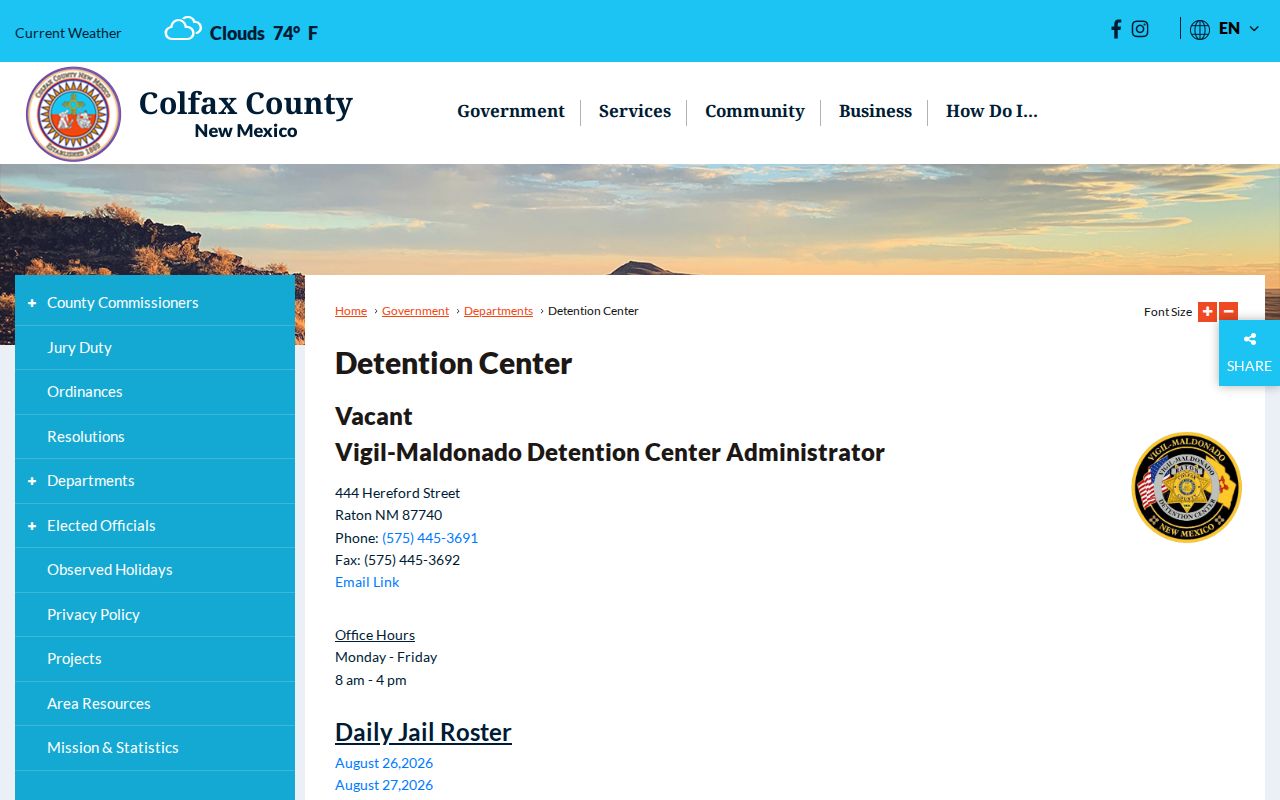
Check the current page itself for live roster dates, since any single view of it ages quickly.
Read Colfax County Blotters Carefully
Start with the official custody record. Build outward from there, and never mash a jail roster, a police activity summary, and a news account into one database.
- Open the VMDC page and note each roster date overlapping the period.
- Read adjacent PDFs because a person may appear after intake or disappear after release or transfer.
- Use the Sheriff's page for a historical month only when it falls within the published archive.
- For Raton activity, review KRTN's monthly blotter and identify the event date and agency.
- Request the arrest report from the originating agency and the booking record from VMDC when needed.
- Use the court docket for the later case result.
Need just the newest roster date? The Arrested Today guide covers that question. A multi-day search is different: it asks what each snapshot and activity report actually published.
What Colfax Arrest Reports May Show
What a Colfax arrest report shows depends on the record series. The state county-sheriff file plan offers an inventory of fields, while the public VMDC page posts no legend at all.
| Possible field | Meaning and limit |
|---|---|
| Name and aliases | Identity lead that needs another identifier. |
| Arrest number | Reference for the arrest report and request. |
| Date, time, location | Event data that may differ from the roster date. |
| Officer or agency | Points to the incident-report custodian. |
| Charges | Charges entered at arrest or booking. |
| Authority and bond | Custody basis and terms that can change. |
| Booking and release | Jail identifiers and custody movement. |
| Mugshot | May exist, but public display is not promised. |
KRTN usually keeps arrests separate from traffic and nontraffic violations and from calls for service. A service call is not an arrest. A person's hometown does not tell you which agency made it.
Weekend Colfax Posting Patterns
Colfax County sets no publication deadline, refresh interval, or holiday schedule for its files. So a PDF labeled with one date is not a full midnight-to-midnight arrest feed. Booking can cross dates. An office post can lag the event. Compare Friday, weekend, and next-business-day files whenever they exist, and note which PDF carried an entry. If a gap matters, call VMDC at (575) 445-3691. Office hours run Monday through Friday, 8 a.m. to 4 p.m. Don't call one change a crime trend without a consistent official dataset behind it.
Some PDFs add a practical problem: the files lack a dependable text layer, so search and copy tools can miss an entry that is plainly visible. Zoom in and read the pages. Never rebook faces elsewhere or turn jail records into a gallery.
Colfax Arrest Archives and Retention
The official Sheriff's archive holds monthly blotters from 2020 through May 2022. KRTN keeps older Sheriff items, including an April 2018 story, alongside current Raton Police posts. Treat all of it as a starting point. Old files prove nothing about VMDC custody today.
The New Mexico retention schedule governs how long records must be kept. Jail inmate files stay at least five years after closure under 1.21.2.902. Law-enforcement case files stay at least ten years under 1.21.2.929. Closure may mean release for an inmate file. For a case file, it may mean a final outcome. Nothing in those rules requires a daily PDF to remain online.
For an older Colfax County record, ask VMDC or the Sheriff first. Name the agency, record type, date range, and format. Request a written response if nothing turns up. Never assume a missing PDF went to the state archive. The official schedule shown here explains how retention works. Those rules hold after a web link disappears.
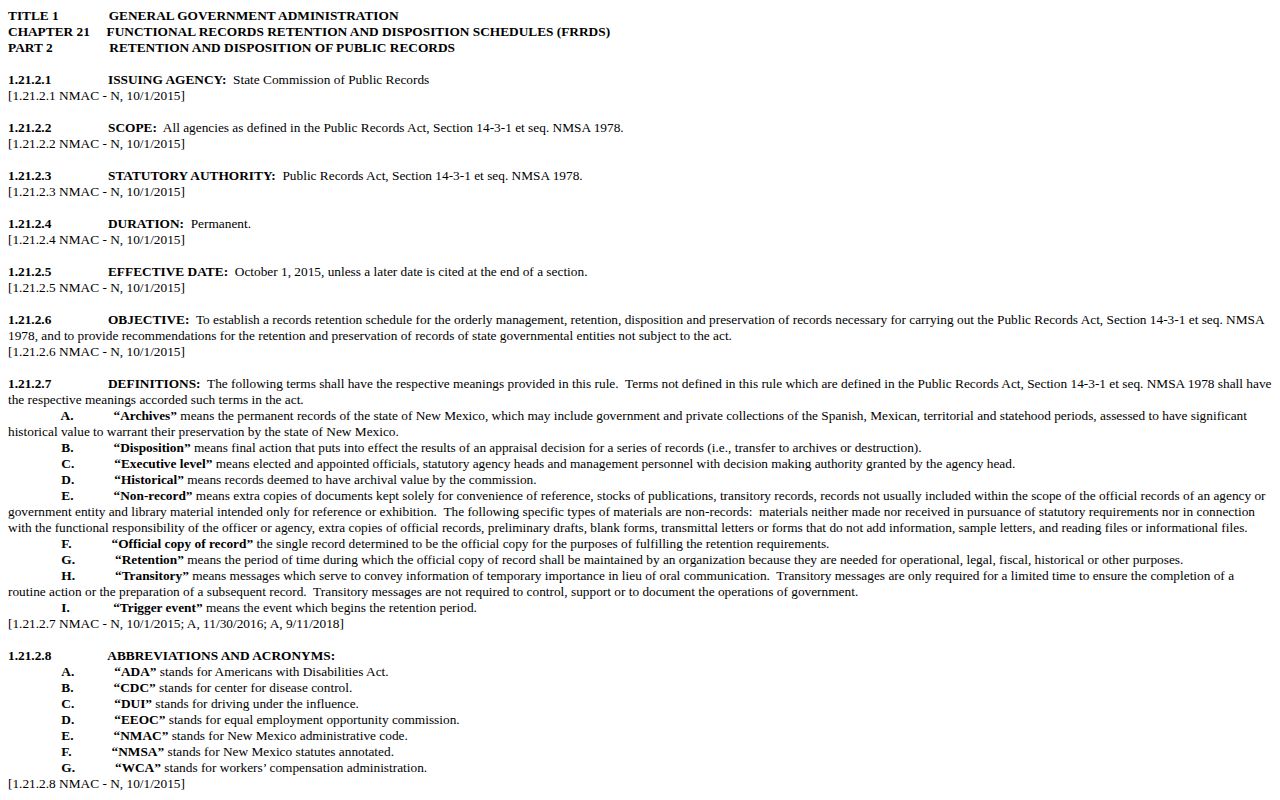
The schedule covers record classes and minimum periods, not a public online log window.
Raton News Arrest Reports
The KRTN Raton Police Blotter posts monthly entries through 2026, running from September back through March. A typical post gives dates or date ranges, person details, and charge wording. Traffic and service-call sections ride along. KRTN is a radio station, not the county jail. The KRTN index displays the monthly news pattern plainly.
Always check an article's date and agency. Then verify the event with the official custodian and the court.
The Ratonian offers another secondary lead. Some items trace to the Sheriff, State Police, Angel Fire, or Springer. Don't tag those as Raton PD activity. Neither Angel Fire nor Springer maintains a current municipal arrest feed.
Request Older Colfax Arrest Records
Sheriff records go to colfaxsheriff@co.colfax.nm.us. Or write the office at 1413 South 2nd Street, Raton, NM 87740, (575) 445-5561. For jail booking and inmate material, contact VMDC at 444 Hereford Street, Raton, NM 87740. Call (575) 445-3691, or email rslade@co.colfax.nm.us. A city or state agency may hold the arrest report separately.
A focused request speeds things up. Name the date range, the originating agency, and any known report or booking number. State the format you want. Ask separately for the arrest report, the inmate file, the release order, and any releasable booking photo. Each can sit in a different record series. Protected, sealed, juvenile, medical, or confidential material may be withheld or redacted.
Colfax Arrest Reports Are Allegations
A Colfax arrest report shows what an agency did, not where a case ends. Charges can be reduced, dismissed, amended, diverted, or resolved after the report appears. For pleas, hearings, and judgments, New Mexico court records are the follow-up source.
An old third-party Colfax page is a poor gauge of present custody. It can linger in search results after a release. It also says nothing about the outcome. Start with official records. Keep the source date close at hand.
Custody categories prevent common mistakes. The newest roster covers people in a dated county-custody snapshot. Release drops a person from a later active roster, yet the arrest report still stands. A transfer to NMCD shifts the status question to the state offender search. Federal custody belongs in the federal locator, not a Colfax blotter. Only the court supplies the later judicial result.
News pages can help build a chronology, especially where the official archive runs old. Copy the date range and agency attribution with care. Capture the exact wording too. Not every service call ends in an arrest. Not every arrest reaches VMDC admission, and not every booking charge survives unchanged. A records request closes those gaps far better than any unofficial index.
Colfax Archive Custody Boundaries
Say a custodian tells you material was transferred. The New Mexico Archives Heritage Search is still only a discovery tool. A catalog hit does not prove a Colfax booking file sits there. State-custody history stays with NMCD, not with Springer. A state prison can carry a Springer address without changing that. County booking records still begin with VMDC or the originating local agency.
The file plan separates arrest reports from incident reports. Release-order files and inmate files sit apart. So do criminal-history records and temporary inmate files. One request may return only part of the event. Ask whether another series holds the booking authority, bond, or release order. The mugshot or final disposition may sit elsewhere. Medical and Social Security details can be withheld. Juvenile or sealed material may carry separate access limits.
When an old public link fails, keep its date and title in your request. Ask whether the record was kept locally or destroyed under schedule. Was it transferred instead? It may also be withheld in whole or in part. A written no-record response beats any conclusion drawn from a dead web page.
An inmate file's retention clock starts at release. A law-enforcement case file's clock starts at closure or final disposition under its series. Neither date matches the roster date, so include both the event date and the disposition date whenever you know them.